

Difficulty Opening Your Mouth? It Could Be a Sign of TMJ Disorder

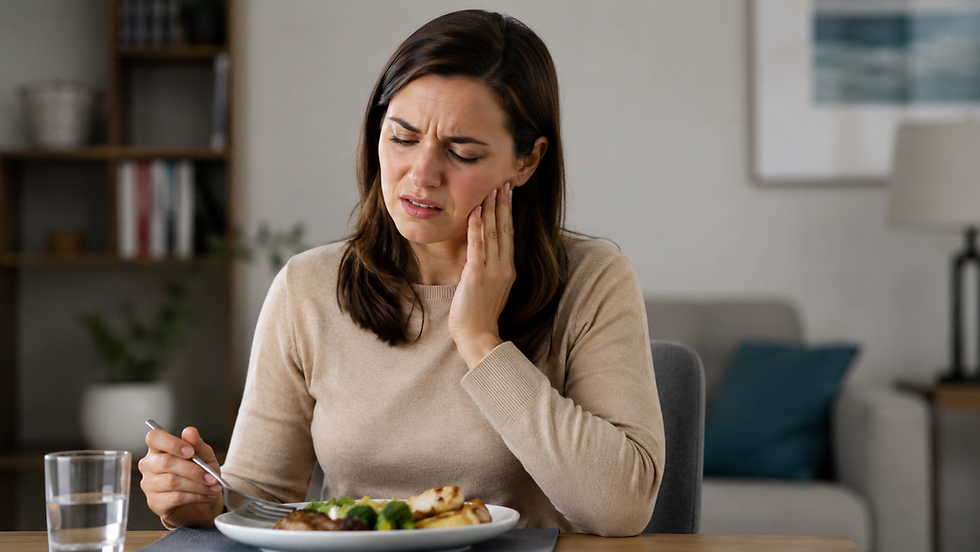
You sit down for breakfast, reach for a hot dosa, and open your mouth the way you have every morning of your life. Except today it stops halfway. There's a dull ache in front of your ear, a strange tightness, and a moment of quiet panic.
Most people brush this off — chew on one side, switch to soft food, hope it settles by the weekend. Sometimes it does. But when the jaw keeps refusing to open, it's usually pointing to something specific in the temporomandibular joint, the small hinge connecting your lower jaw to your skull just in front of each ear.
How Wide Should Your Mouth Open?
A healthy adult jaw opens roughly 40 to 60 millimetres, measured between the upper and lower front teeth. Quick check at home: stack three of your own fingers vertically and slide them between your front teeth. If all three fit without strain, your opening is probably normal.
When opening falls to 20 to 35 millimetres or less, it's called trismus. At that point a full meal, a yawn, or even a routine dental visit becomes a struggle. The number matters because it's measurable — it gives you and your clinician something objective to track instead of guessing.
Why the Jaw Refuses to Open
The temporomandibular joint is unusual. It doesn't simply hinge — it rotates, then slides forward, with a small cartilage disc travelling between the ball and socket. When that coordination breaks down, or the surrounding muscles clamp shut, opening becomes restricted.
1. Disc Displacement — the "Closed Lock"
The classic story. For months or years the jaw clicks every time it opens. Then one day the clicking stops — and so does the opening. It feels like something is blocking the joint, because it is: the disc has slipped forward and no longer slides back into place.
People often feel relieved when the clicking finally disappears. It's usually a warning sign, not a recovery.
2. Muscle Guarding, Clenching and Grinding
Not every case involves the joint itself. Overworked chewing muscles — the masseter and temporalis — can go into protective spasm and refuse to lengthen. Night grinding, work stress, poor sleep and long hours hunched over a laptop all feed into this. The jaw feels tired and stiff, worst in the morning.
3. Arthritis and Joint Wear
Osteoarthritis, rheumatoid arthritis and old injuries roughen the joint surfaces. Expect a gritty or crackling sound, morning stiffness, and opening that shrinks gradually over months.
4. Oral Submucous Fibrosis
This one deserves particular attention in India. Long-term use of gutkha, pan masala or areca nut stiffens and scars the tissue inside the cheeks. Mouth opening reduces slowly and steadily, the cheeks feel leathery, and spicy food starts to burn. It's classed as a potentially malignant disorder, so it needs early assessment rather than wait-and-watch.
5. After Dental Work, Injury or Infection
Wisdom tooth removal, a long dental appointment, a local anaesthetic injection, a fall, or a spreading dental infection can all limit opening. Restricted opening with fever and facial swelling needs same-day medical attention.
Signs You Shouldn't Wait Out
Get assessed if you notice any of these:
The jaw locks shut, or locks open, even briefly
Three fingers no longer fit between your front teeth
Pain in front of the ear that worsens while chewing
The jaw shifts to one side as it opens
Long-standing clicking that suddenly stopped
Temple headaches, ear fullness or ringing with no ear infection
Steady tightening in anyone using areca nut or tobacco
The National Institute of Dental and Craniofacial Research notes that painless clicking on its own is common and usually needs no treatment. Restricted opening with pain is a different matter.
What Helps Right Now — and What Makes It Worse
While you arrange an appointment, a few measures are safe and often settle an irritable jaw:
Soft diet for a few days — skip chewing gum, hard crusts and tough meat
Moist heat over the jaw muscles, 10–15 minutes, two or three times a day
Support your chin with your hand when you yawn
Catch yourself clenching: teeth apart, lips together, tongue resting on the palate
One caution matters more than the rest: don't force the jaw open. Wrenching it wider, or letting someone stretch it aggressively, can inflame the joint further. Stretching has a place in treatment, but only when it's guided and matched to the diagnosis.
Getting the Diagnosis Right
Guesswork is the main reason TMJ problems drag on for years. A dependable assessment measures mouth opening and movement patterns, examines the muscles and joint by hand, and reviews your habits, stress, sleep and bite history.
Imaging is added where it changes the plan. A 3D CBCT scan shows the bony joint surfaces and condyle position far more clearly than a routine dental X-ray. Bite analysis and muscle testing help separate a muscle problem from a disc problem — a distinction that matters, because the treatment for each isn't the same.
What Treatment Usually Involves
International guidance agrees on one point: start with the simplest, most reversible options. Most people improve without surgery.
A typical conservative plan combines short-term jaw rest and a soft diet, heat or cold packs, guided stretching or physiotherapy, anti-inflammatory medication where appropriate, low-frequency TENS therapy to relax the chewing muscles, and a custom oral orthotic to unload the joint. Habit correction, stress management and sleep support carry more weight than most patients expect.
Irreversible steps — surgery, joint implants, or permanently reshaping the teeth — should only follow a fair trial of conservative care, ideally with a second opinion.
Looking for TMJ Treatment in Chennai?
If you're searching for TMJ treatment in Chennai, look past the marketing and ask practical questions. Does the clinic measure and record your mouth opening in millimetres? Are you given a specific diagnosis, or just a general "it's TMJ"? Is imaging done in-house? Is the plan non-surgical first? Will someone review your progress in a few weeks?
Diagnox Oral Medicine & Radiology Centre has focused exclusively on TMJ and orofacial pain since 2016. We're based in Marthandam, Kanyakumari district, and patients travel to us from Chennai, Coimbatore, Madurai, Trichy and across Kerala. Assessment uses CBCT and OPG imaging, OccluSense bite analysis and J5 Myomonitor TENS therapy; treatment is non-surgical. If you're coming from Chennai, call ahead so consultation and imaging can be planned into one visit.


Comments